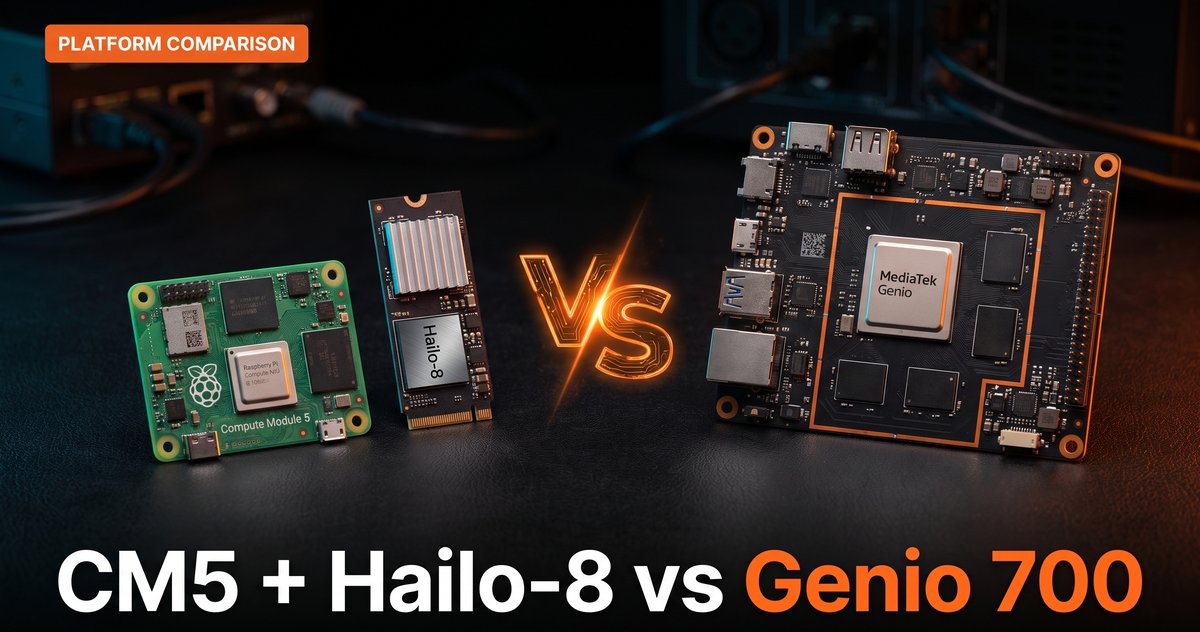
Raspberry Pi CM5 + Hailo-8 vs MediaTek Genio 700
Raspberry Pi CM5 plus a Hailo accelerator is the default answer right now for teams building a vision product on a budget, and the MediaTek Genio 700 is the option most of those teams have never priced. We build camera and edge AI devices on both sides of this fence, so this comparison is the one we actually walk clients through: CM5 + Hailo-8 versus Genio 700, judged as the compute for a real product rather than a demo.
Key Insights
- The CM5 has no hardware video encoder. If your product streams or records video, that single line item dominates the comparison, and adding a Hailo module does nothing to change it.
- Hailo-8 crushes the Genio 700 on raw inference: 26 TOPS against a 4 TOPS class integrated APU. For inference-only products with no streaming requirement, CM5 + Hailo is a strong, well-supported combination.
- Genio 700 is the integration play: hardware H.264/H.265 encode and decode, an integrated ISP, an NPU, and WiFi 6 support in one SoC and one BSP, with no M.2 module or second AI toolchain.
- Ecosystem maturity still favors Raspberry Pi by a wide margin. Genio trades community volume for vendor-supported Yocto and Ubuntu BSPs and an industrial supply posture.
What are you actually comparing?
Raspberry Pi CM5 is a compute module built on the BCM2712: four Cortex-A76 cores at 2.4 GHz, VideoCore VII graphics, up to 16 GB of LPDDR4X, two four-lane MIPI CSI/DSI interfaces, and one lane of PCIe. It inherits the Pi 5’s codec decision: hardware HEVC decode only. H.264 decode and all encoding moved to software.
Hailo-8 is an inference accelerator that attaches over that PCIe lane (M.2 modules, or the HAT form factors the Pi ecosystem ships). It is rated at 26 TOPS INT8 at a couple of watts, with its own compiler toolchain that converts ONNX or TensorFlow models into Hailo’s dataflow format. The popular Raspberry Pi AI Kit pairs the smaller Hailo-8L at 13 TOPS.
MediaTek Genio 700 is a single SoC (MT8390) aimed at exactly this product class: two Cortex-A78 cores plus six Cortex-A55, Mali-G57 graphics, an integrated 4 TOPS class APU (the MDLA NPU we cover in APU vs NPU vs VPU vs MDLA), an integrated ISP, MIPI CSI camera inputs, and hardware encode and decode for H.264 and H.265.
| Raspberry Pi CM5 + Hailo-8 | MediaTek Genio 700 | |
|---|---|---|
| CPU | 4× Cortex-A76 @ 2.4 GHz | 2× Cortex-A78 + 6× Cortex-A55 |
| AI | Hailo-8: 26 TOPS (discrete, PCIe) | Integrated APU, 4 TOPS class |
| Video encode | None (software x264/x265 on CPU) | Hardware H.264 + H.265 |
| Video decode | HEVC hardware; H.264 software | Hardware H.264 + H.265 |
| ISP | Pi ISP + libcamera | Integrated ISP (full RAW pipeline via MediaTek’s camera stack) |
| Camera inputs | 2× 4-lane MIPI CSI (shared with DSI) | MIPI CSI via SENINF, multi-camera capable |
| OS | Raspberry Pi OS, community Linux | Yocto (RITY) and Ubuntu BSPs from MediaTek |
| AI toolchain | Hailo Dataflow Compiler | TFLite delegate / ONNX Runtime on the NPU |
| Parts and vendors | Module + accelerator, two toolchains | One SoC, one BSP |
| Supply commitment | CM5 in production to at least Jan 2036 | Genio 10-year industrial supply plan |
Why does the missing video encoder matter so much?
Because almost every camera product ships video somewhere: an RTSP stream to a recorder, WebRTC to a browser, clips to storage. On the CM5 that pipeline runs through a software encoder. x264 at 1080p30 is achievable on the A76 cores, but it takes a large, permanent bite of your CPU budget, and it scales badly: a second camera, a higher resolution, or a tighter power envelope and the math stops working. The encoder load also lands on the same cores that run your application and feed the Hailo, so inference-plus-streaming products hit the wall first.
On the Genio 700 the same pipeline runs through dedicated encoder hardware behind standard V4L2 and GStreamer interfaces, the same stack we describe in our Genio real-time video guide. We have shipped hardware-encoded multi-stream pipelines on Genio parts, and the CPU cost of encode is effectively noise. H.265 support matters double here: for bandwidth-limited links, hardware HEVC encode is the difference between one stream and none.
If your product does not encode video at all, a kiosk, a sensor gateway, a pure inference box feeding structured data upstream, this entire section is moot, and the comparison tilts back toward the Pi.
How do the AI stacks compare?
On throughput, it is not close: Hailo-8’s 26 TOPS runs bigger models, higher frame rates, and multi-model pipelines that the Genio’s 4 TOPS class APU cannot match. If your roadmap includes heavy detection plus tracking plus classification running concurrently, the Hailo is the honest choice, and its toolchain is mature.
The Genio’s case is architectural rather than raw speed. The NPU is behind standard frameworks (TFLite’s Neuron delegate, ONNX Runtime’s NeuronExecutionProvider, covered in ONNX Runtime on the Genio NPU), so there is no separate accelerator vendor, no proprietary model compilation step in your build, and no PCIe attachment to design, power, and cool. On the CM5 side, the Hailo also inherits the Pi’s constraint: a single PCIe lane feeding it, and host-side pre and post processing competing with everything else on four cores.
The question we ask clients: what does your model actually need? Measured requirements in the 2 to 4 TOPS range with one or two models resident are comfortably inside the Genio 700. Requirements in the tens of TOPS point at Hailo, or at a bigger integrated platform entirely.
What about the camera and ISP path?
The Pi camera stack is the most approachable in embedded: libcamera, a huge catalog of community-supported sensors, and enormous documentation volume. Its limits show up at the edges: exotic sensors, multi-camera synchronization, and fine ISP control get harder as requirements sharpen.
Genio’s camera path is the industrial inverse. Sensor bring-up runs through MediaTek’s SENINF and ISP stack with vendor support behind it, multi-camera topologies are a designed-for case, and the full RAW Bayer processing pipeline is available, with the caveat that the complete ISP tuning stack sits behind MediaTek’s NDA program, which we explain in NDA vs public build on Genio. For products where image quality in hard conditions is a requirement rather than a preference, that vendor ISP path, with proper tuning, is worth real money.
Ecosystem, supply, and the second vendor problem
Raspberry Pi’s ecosystem advantage is real and we will not pretend otherwise: more engineers know it, more problems are one search away, and prototyping speed is unmatched. Genio answers with vendor-maintained Yocto and Ubuntu BSPs, an industrial supply posture (see our Genio longevity notes), and a support relationship where sensor, ISP, and BSP questions have someone accountable on the other end.
The CM5 + Hailo pairing also quietly makes you a systems integrator: two vendors, two roadmaps, two toolchains, and a PCIe interface between them that is yours to validate across temperature and production spread. One SoC does not have that failure mode. BOM math follows the same logic: module plus accelerator plus carrier complexity against one SoC with more of the product integrated into it.
Which one should you pick?
Choose CM5 + Hailo-8 when your product is inference-first and streams little or no video, when raw TOPS is the requirement that dominates, or when time-to-first-demo and ecosystem familiarity outweigh integration cost. It is a genuinely good platform inside those lines.
Choose Genio 700 when the product is a camera device that encodes, when multi-camera or serious ISP requirements are on the roadmap, when power and BOM force integration, or when you want one accountable vendor under the whole board support package. The pattern we see repeatedly: teams prototype on the Pi stack, ship v1 into the encoder wall or the integration overhead, and land on an integrated SoC for v2. If that arc sounds familiar, price the migration before v1 hardens; it is cheaper as a plan than as a rescue.
Weighing this exact decision for a device? We do platform selection and bring-up on both stacks and will tell you honestly which side your requirements land on. Talk to us about MediaTek Genio engineering.
Sources: Raspberry Pi CM5 documentation, Hailo-8 product page, and MediaTek Genio 700 product page.
Relevant Services
MediaTek Genio Expert Support
Building on MediaTek Genio?
BSP bring-up, GStreamer pipelines, NeuroPilot integration, we've shipped it. Get unblocked fast. One call to scope it, fixed bid to deliver it.
Frequently Asked Questions
Does the Raspberry Pi CM5 have a hardware video encoder?
No. The BCM2712 in the CM5 and Pi 5 dropped the hardware video encoder entirely, and H.264 decode is software as well; the only hardware codec path is HEVC decode. Any camera product that needs to stream or record H.264 or H.265 on a CM5 encodes in software on the Cortex-A76 cores, which costs sustained CPU load, power, and thermal headroom.
Does adding a Hailo-8 fix the CM5's video encoding problem?
No. Hailo-8 is a neural network inference accelerator. It runs vision models fast at low power, but it contains no video encoder, so the encode gap remains. Pairing CM5 with Hailo gives you strong inference plus software-only encoding, which is exactly the wrong combination for products that must do camera capture, AI, and streaming at the same time.
Is the MediaTek Genio 700 better than CM5 plus Hailo-8 for AI workloads?
Not on raw inference throughput. Hailo-8 is rated at 26 TOPS while the Genio 700's integrated APU is a 4 TOPS class NPU, so heavy multi-model pipelines favor the Hailo. The Genio wins when the whole product is considered: hardware H.264/H.265 encode, an integrated ISP, and the NPU all in one SoC, with no PCIe module, extra power rail, or second vendor toolchain.
How hard is it to migrate from Raspberry Pi to MediaTek Genio?
Plan for a platform bring-up rather than a rebuild. You move from Raspberry Pi OS and libcamera to a Yocto or Ubuntu image with MediaTek's BSP, camera drivers move to the Genio's sensor interface and ISP stack, and AI models move from the Hailo toolchain to TFLite or ONNX Runtime on the NPU. Application code in Python, GStreamer, or Docker containers ports with modest changes. Teams typically hold the Pi variant stable while standing up the Genio image in parallel.
What about long-term supply for CM5 versus Genio 700?
Both are strong. Raspberry Pi commits the CM5 to production until at least January 2036, and MediaTek positions Genio as an industrial line with a 10-year supply plan. Supply longevity is rarely the deciding factor between these two; the deciding factors are the encoder, the camera path, and how much integration your BOM can absorb.
Written by
Andrés CamposCo-Founder & CTO · ProventusNova
8 years deep in embedded systems, from underwater ROVs to edge AI. Andrés leads every technical delivery personally.
Connect on LinkedInRelated Articles
MediaTek Genio vs NVIDIA Jetson Orin: which platform for edge AI
MediaTek Genio vs NVIDIA Jetson Orin for edge AI products. Compute, camera support, BSP maturity, ecosystem, and which platform wins for robotics.
NPU vs CPU on the MediaTek Genio: the Thermal Reality
On a fanless MediaTek Genio, running a vision model on the CPU pushed our robot to 84 C and throttled. On the NPU it held 58 C. Why edge AI is a heat problem.
MediaTek Genio 420: specs, Yocto BSP, and how it compares to Genio 520 and 720
MediaTek Genio 420 (MT8371LV) is the low-voltage Genio 520 variant. Same EVK, Yocto BSP, ONNX NPU EP. Specs, limitations, and when to choose 420 vs 520 vs 720.
Genio 510 vs 700 vs 1200: which MediaTek module for your product
MediaTek Genio 510 vs 700 vs 1200 comparison for embedded AI products. AI TOPS, camera lanes, memory, power, and which module fits which application.