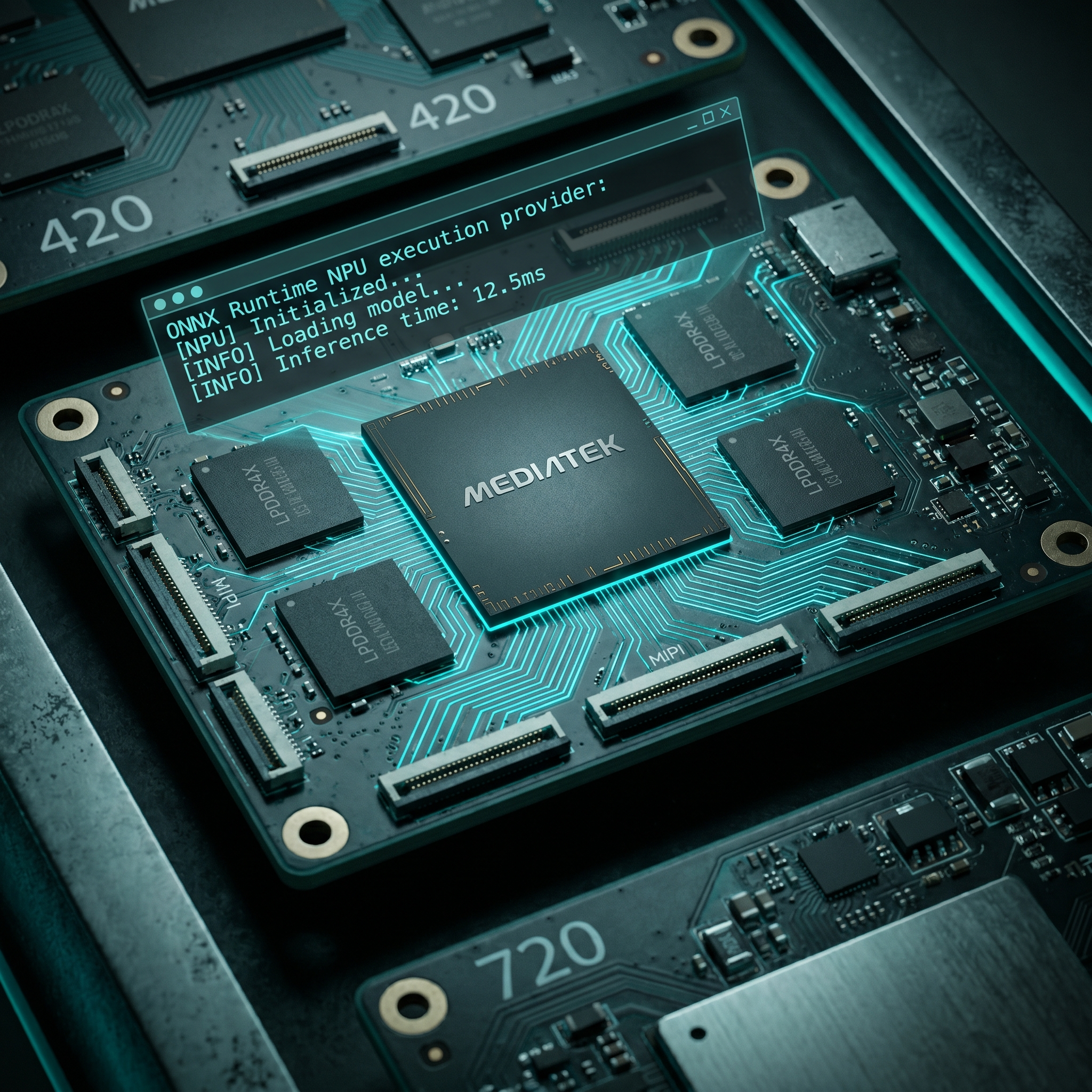
MediaTek Genio 420: specs, Yocto BSP, and how it compares to Genio 520 and 720
MediaTek Genio 420 is the low-voltage variant of Genio 520, sharing the same silicon, EVK board, and Yocto BSP. If you are evaluating the Genio 420 and wondering how it fits against the 520 and 720, the answer starts with the SoC family structure: all three platforms are development targets for the same codebase, the same machine config, and the same EVK.
Key Insights
- Genio 420 (MT8371LV) is pin-compatible with Genio 520 (MT8371) and 720 (MT8391): same VFBGA footprint, same EVK board (P2V3), same Yocto
genio-720-*machine configs - No HDMI on any of these three platforms: display output is DisplayPort over Type-C (DPoC) only; this is the most common hardware surprise for teams coming from desktop or Genio 510/700/1200 designs
- ONNX Runtime NPU Execution Provider is only supported on Genio 420/520/720: not on Genio 510, 700, or 1200; if your inference stack uses ONNX Runtime with NPU acceleration, this family is the correct choice
- LP4X memory support (up to 8GB) makes 420 and 520 lower BOM cost than 720 (which requires LP5X)
- Genio 420 BSP support added March 2026 in IoT Yocto v25.1.1, the 420 is a new addition to an otherwise stable BSP
What is the Genio 420?
The MediaTek Genio 420 (SoC part number: MT8371LV) is the low-voltage, industrial-grade member of the MT8391/MT8371 SoC family. The LV suffix means lower operating voltage, the same die as MT8371 (Genio 520), manufactured to meet tighter voltage specifications, which reduces power consumption and thermal output at the cost of slightly lower peak clock headroom.
In practice, the Genio 420 and Genio 520 are software-identical. They share the same datasheet (“MT8391 MT8371 MT8371LV Application Processor Datasheet”), the same EVK user guide, the same Yocto machine configurations, and the same driver support. MediaTek added all three platforms to the same BSP release.
Genio 420 full specifications
| Property | Genio 420 (MT8371LV) |
|---|---|
| SoC | MT8371LV |
| Process node | 6nm |
| CPU | 2× Cortex-A78 @ 2.2 GHz + 6× Cortex-A55 |
| GPU | Mali-G57 MC2 @ 880 MHz |
| NPU | APUSys / MDLA (same as Genio 520 and 720) |
| Max RAM | 8 GB LPDDR4X or LPDDR5 |
| Storage interfaces | eMMC, UFS, SD |
| MIPI CSI-2 | 3× 4-lane |
| MIPI DSI | 2 |
| Display output | DisplayPort over Type-C (DPoC) only, no HDMI |
| PCIe | 1× Gen2 |
| GbE | 1× TSN-capable |
| USB | USB 3.x |
| GPIO | 177 |
| I2C | 8 + 2 I3C |
| SPI | 6 master |
| UART | 4 |
| WiFi / BT | External via MT7921 (M.2/PCIe) |
| Package | Same VFBGA as MT8371/MT8391 |
| Longevity | Until 2032 |
Genio 420 vs Genio 520 vs Genio 720
The three platforms differ in clock speed and memory, not in silicon architecture or peripheral set.
| Genio 420 (MT8371LV) | Genio 520 (MT8371) | Genio 720 (MT8391) | |
|---|---|---|---|
| CPU A78 clock | 2.2 GHz | 2.2 GHz | 2.6 GHz |
| GPU clock | 880 MHz | 880 MHz | 1.1 GHz |
| NPU | APUSys/MDLA | APUSys/MDLA | APUSys/MDLA |
| Max RAM | 8 GB LP4X | 8 GB LP4X or 16 GB LP5 | 16 GB LP5X |
| Memory type | LP4X | LP4X or LP5 | LP5X |
| Display | DPoC only | DPoC only | DPoC only |
| Yocto machine | genio-720-evk | genio-720-evk | genio-720-evk |
| EVK board | P2V3 | P2V3 | P2V3 |
| ONNX Runtime NPU EP | Yes | Yes | Yes |
| BSP support since | v25.1.1 (Mar 2026) | v25.1 (Dec 2025) | v25.1 (Dec 2025) |
| Longevity | Until 2032 | Until 2032 | Until 2036 |
The software difference between the three is zero, same machine config, same BSP, same driver stack. A driver written and tested on Genio 720 EVK runs on Genio 420 without changes.
The hardware difference is clock speed, memory ceiling, and supply voltage. For applications that do not saturate the Genio 720’s CPU or GPU, the 420 and 520 run the same software at lower power and lower BOM cost.
Where Genio 420 fits vs the broader Genio family
The broader Genio family splits into two groups with different BSP lineages and different display capabilities:
| Genio 350/360/510/700/1200 | Genio 420/520/720 | |
|---|---|---|
| HDMI output | Yes | No, DPoC only |
| ONNX Runtime NPU EP | No (except 520/720) | Yes |
| TFLite Neuron Stable Delegate | Yes (most models) | Yes |
| Yocto machine | Platform-specific | genio-720-* shared |
| Pin-compatible group | No cross-compatibility | All three compatible |
The most important distinction for software teams: if your inference deployment stack uses ONNX Runtime and you need NPU acceleration, only Genio 420, 520, and 720 support the ONNX Runtime NPU Execution Provider (MDLA backend). The other Genio platforms support MDLA only through TFLite’s Neuron Stable Delegate. This is a framework-level choice that affects your entire inference stack.
When to choose Genio 420 over 520 or 720
Choose Genio 420 when:
- Your design is thermally constrained, the lower operating voltage reduces heat output, which matters in sealed industrial enclosures without active cooling
- You are targeting battery-powered operation, lower voltage directly reduces active power draw
- BOM cost matters and your workload does not saturate Genio 520 clock speeds
- You need ONNX Runtime NPU EP support but do not need Genio 720’s higher CPU/GPU clocks
Choose Genio 520 instead when:
- You want the same power profile as Genio 420 but with broader BSP history (520 support predates 420 by one release)
- LP5 memory support matters for your bandwidth requirements
Choose Genio 720 instead when:
- You need 2.6 GHz A78 cores, meaningful for CPU-bound workloads like computer vision pre/post-processing
- You need 1.1 GHz GPU clocks, relevant for GPU-accelerated inference or rendering
- You need LP5X memory at 16 GB
- Longevity is critical, Genio 720 is guaranteed until 2036 vs 2032 for 420/520
Yocto BSP status and known limitations
Genio 420 support was added to the MediaTek IoT Yocto SDK in v25.1.1 (March 2026). This is a recent addition and carries some known gaps as of this BSP release:
- ISP hardware pipeline not supported: The MIPI-CSI interface transfers raw sensor data, but the ISP hardware processing pipeline is not yet active in v25.1.x. Camera bring-up is possible for raw capture, but ISP-processed output (auto-exposure, auto-white-balance, hardware noise reduction) is not available yet.
- Boot splash / bootloader display driver not supported in v25.1.x on this platform family.
- Generative AI on Yocto: Available on Genio 720 as of early 2026. Genio 420 and 520 are expected to gain GAI support in 2026 Q2 (same model support, slightly lower throughput due to lower clock rates).
The ONNX Runtime NPU Execution Provider and TFLite Neuron Stable Delegate (MDLA backend) are both supported and stable on all three platforms.
No HDMI: the one thing to verify before committing
Genio 420, 520, and 720 have no HDMI output. This is documented in the MediaTek design notice for this SoC family and is not a BSP limitation, the hardware simply does not include an HDMI transmitter.
Display output is via DisplayPort over Type-C (DPoC) only. In your Yocto build, enable it with:
KERNEL_DEVICETREE_OVERLAYS += "mediatek/mt8391-evk-display-dpoc.dtbo"
For headless applications (no display required), this is irrelevant. For applications requiring HDMI output to a monitor or TV, choose Genio 510, 700, or 1200 instead. For applications requiring MIPI DSI to a panel, Genio 420/520/720 expose two DSI interfaces.
Developing on Genio 420
Because Genio 420 shares its EVK board and Yocto machine config with Genio 520 and 720, you develop on the P2V3 EVK regardless of which target SoC you plan to use in production. Build with the genio-720-evk machine:
MACHINE=genio-720-evk bitbake core-image-base
The bootloader auto-detects DRAM type (LP4X or LP5X) and capacity at runtime, so the same image boots across all three platforms without modification. Flash with genio-flash as you would for Genio 720.
For a comparison of the broader Genio family against NVIDIA Jetson for edge AI applications, see MediaTek Genio vs NVIDIA Jetson Orin.
MediaTek’s official Genio product pages are at iot.mediatek.com/genio. The MT8391/MT8371/MT8371LV datasheet is available through the MediaTek developer portal after registration.
Relevant Services
MediaTek Genio Expert Support
Building on MediaTek Genio?
BSP bring-up, GStreamer pipelines, NeuroPilot integration, we've shipped it. Get unblocked fast. One call to scope it, fixed bid to deliver it.
Frequently Asked Questions
What is the MediaTek Genio 420?
The MediaTek Genio 420 (SoC: MT8371LV) is the low-voltage, industrial-grade variant of the Genio 520 (MT8371). It uses the same 6nm silicon, the same 2×Cortex-A78 + 6×Cortex-A55 CPU cluster, and the same APUSys/MDLA NPU as the Genio 520 and 720. The LV suffix indicates lower operating voltage, making it suited for thermally constrained and battery-powered designs. All three platforms, Genio 420, 520, and 720, share the same EVK board and Yocto machine configurations.
What is the difference between Genio 420 and Genio 520?
Genio 420 (MT8371LV) is the low-voltage variant of Genio 520 (MT8371). The silicon is the same, same CPU cluster (2×A78 @2.2 GHz + 6×A55), same Mali-G57 MC2 GPU, same APUSys/MDLA NPU, same peripheral set. The 420 runs at lower voltage, which reduces power consumption and heat output at the cost of slightly reduced peak operating headroom. Both support LPDDR4X up to 8GB. For software, they are identical, same EVK board, same Yocto machine configs, same driver support.
Does the Genio 420 support ONNX Runtime NPU acceleration?
Yes. Genio 420 and Genio 520 are among the only Genio platforms that support ONNX Runtime with the NPU Execution Provider (MDLA backend). Genio 510, 700, and 1200 do not support ONNX Runtime NPU EP, only TFLite with Neuron Stable Delegate for MDLA inference. If your inference pipeline is built on ONNX Runtime and you need NPU acceleration on Genio, the 420/520/720 family is the correct choice.
Does Genio 420 have HDMI output?
No. Genio 420, 520, and 720 do not have an HDMI display interface. The only external display path on these platforms is DisplayPort over Type-C (DPoC). Load the display-dpoc.dtbo device tree overlay to enable it. Genio 510, 700, and 1200 have HDMI. If HDMI output is a hard requirement for your product, choose a different Genio platform.
What Yocto BSP version added Genio 420 support?
Genio 420 (MT8371LV) support was added to the MediaTek IoT Yocto SDK in v25.1.1 (released March 2026). The underlying Yocto BSP framework was introduced in v25.1 (December 2025) alongside Genio 520 and 720. All three use the same genio-720-evk machine configuration. No separate machine config exists for Genio 420, the bootloader auto-detects the DRAM type and size at runtime.
Is the Genio 420 pin-compatible with Genio 520 and 720?
Yes. MT8371LV (Genio 420), MT8371 (Genio 520), and MT8391 (Genio 720) share the same VFBGA package footprint. A carrier board designed for Genio 720 can accept Genio 420 or 520 without hardware changes. This makes the 420 a drop-in for cost or power optimization once you have validated your design on the 720 EVK. Note that MT8395 (Genio 1200) uses a 15×15mm package and is not pin-compatible with this family.
What is the longevity commitment for Genio 420?
MediaTek has committed Genio 420 availability until 2032. This is shorter than Genio 720 (until 2036) but sufficient for most product lifecycles in the 5–7 year range. For products requiring the longest supply commitment in the 420/520/720 family, Genio 720 provides four additional years of guaranteed availability.

Written by
Aarón AnguloCo-Founder & CEO · ProventusNova
Obsessed with client outcomes. Aarón ensures every engagement delivers real results, on time, on scope, no exceptions.
Connect on LinkedInRelated Articles
Genio 510 vs 700 vs 1200: which MediaTek module for your product
MediaTek Genio 510 vs 700 vs 1200 comparison for embedded AI products. AI TOPS, camera lanes, memory, power, and which module fits which application.
Running ROS 2 on the MediaTek Genio
ROS 2 runs well on the MediaTek Genio, and containers on a custom Yocto image make it reproducible. What the stack looks like and the gotchas to expect.
NPU vs CPU on the MediaTek Genio: the Thermal Reality
On a fanless MediaTek Genio, running a vision model on the CPU pushed our robot to 84 C and throttled. On the NPU it held 58 C. Why edge AI is a heat problem.
Jetson Orin AGX vs Orin NX vs Orin Nano: which to pick
Compare Jetson AGX Orin, Orin NX, and Orin Nano on TOPS, memory bandwidth, I/O, power, and price. Pick the right module for your edge AI project.