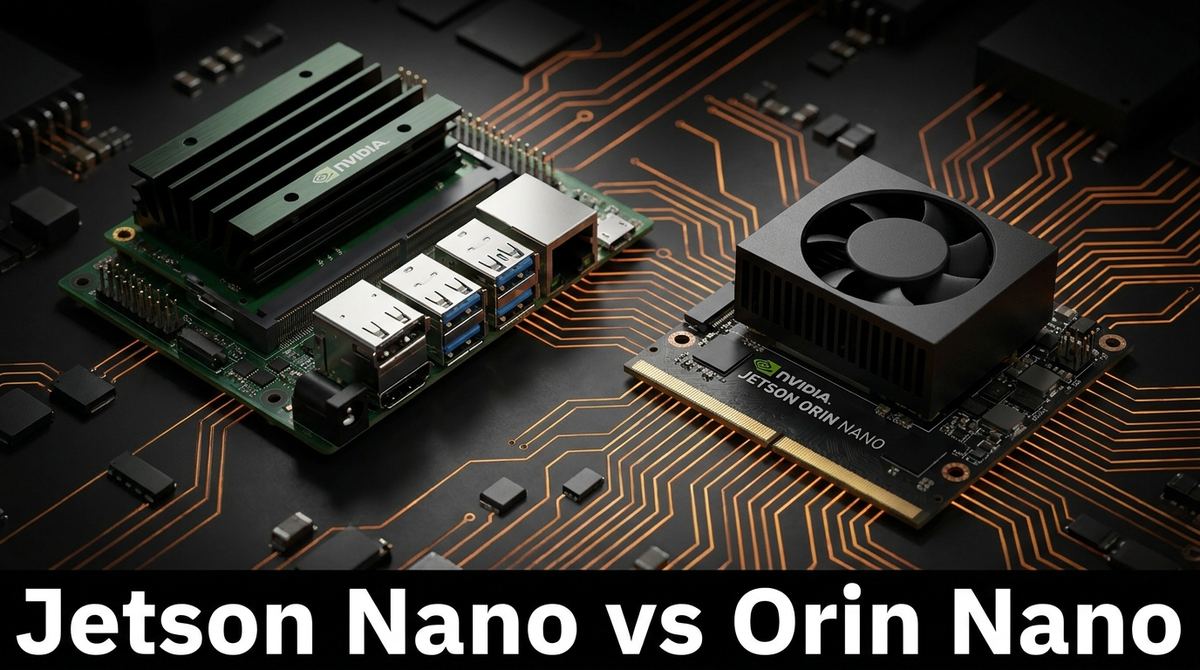
Jetson Nano vs Orin Nano: Same Name, Different Chip
“Jetson Nano vs Orin Nano” shows up in search a lot lately, mostly from people who assume this is a simple hardware refresh, order an Orin Nano devkit, and then discover their old Jetson Nano image doesn’t boot, their carrier board doesn’t fit the module, and their camera driver doesn’t load. It isn’t a refresh. Jetson Nano and Orin Nano share a product name and a rough price point, and almost nothing else.
Key Insights
- Jetson Nano (Tegra X1, Maxwell GPU, 2019) and Orin Nano (Orin SoC, Ampere GPU, 2023) are two full GPU generations apart, not a version bump
- Jetson Nano is end-of-life with a last shipment date of January 2027; Orin Nano is active through January 2032
- The two modules use the same 260-pin SO-DIMM connector standard but different pinouts, they are not interchangeable on the same carrier board
- Software is not forward compatible: Jetson Nano tops out at JetPack 4.6.x (CUDA 10.2, Ubuntu 18.04); Orin Nano runs JetPack 6.x (CUDA 12.6, Ubuntu 22.04)
- NVIDIA rates Nano at 472 GFLOPS (FP16) and Orin Nano at up to 40 TOPS (quantized inference), different units measuring different things, but every directly comparable axis, CUDA core count, memory bandwidth, real-world inference speed, moved by a full order of magnitude or more
What’s different between Jetson Nano and Orin Nano?
Jetson Nano runs NVIDIA’s Tegra X1 SoC, the same chip family used in the original Nintendo Switch, with a Maxwell-generation GPU: 128 CUDA cores, no Tensor Cores, no DLA, quad-core ARM Cortex-A57 CPU, and 4GB of LPDDR4 at 25.6 GB/s. It launched in 2019 as a low-cost entry point into Jetson development and was never meant to be a production AI inference platform, more a way to get students and hobbyists writing CUDA code on cheap hardware.
Orin Nano runs the Orin SoC, an Ampere-generation GPU with either 512 or 1024 CUDA cores depending on the 4GB or 8GB variant, an 8-core (4GB) or 6-core (8GB) ARM Cortex-A78AE CPU, and up to 68.3 GB/s of memory bandwidth. It’s a genuinely current platform, sharing its architecture with the same Orin family used in AGX Orin and Orin NX production designs. See Jetson Orin AGX vs Orin NX vs Orin Nano if you’re also deciding between Orin variants.
| Jetson Nano | Orin Nano 8GB | |
|---|---|---|
| SoC | Tegra X1 | Orin (T234) |
| GPU architecture | Maxwell | Ampere |
| CUDA cores | 128 | 1024 |
| CPU | Quad-core Cortex-A57 | 6-core Cortex-A78AE |
| Memory | 4GB LPDDR4 | 8GB LPDDR5 |
| Memory bandwidth | 25.6 GB/s | 68.3 GB/s |
| AI performance | 472 GFLOPS (FP16) | 40 TOPS |
| DLA | None | None |
| CUDA version | 10.2 | 12.6 |
| JetPack / L4T | 4.6.x / R32.7.x | 6.2.2 / R36.5.0 |
| Ubuntu base | 18.04 | 22.04 |
| Connector | 260-pin SO-DIMM (Nano/TX1/TX2 NX family) | 260-pin SO-DIMM (Orin NX/Nano/Xavier NX family) |
| Lifecycle status | End of life, last shipment Jan 2027 | Active through Jan 2032 |
Neither module has a DLA (Deep Learning Accelerator), the fixed-function inference block present on AGX Orin and Orin NX. If your workload leans on DLA offload, Orin NX is the module to look at, not Orin Nano.
Same connector, different pinout: the carrier board trap
This is the mistake we see most often. Jetson Nano and Orin Nano both use a 260-pin SO-DIMM style module connector, so a board with the right physical socket looks compatible at a glance. It isn’t.
Jetson Nano’s pinout is shared with Jetson TX1 and TX2 NX, an older pin mapping tied to the Tegra X1/X2 I/O layout. Orin Nano’s pinout is shared with Orin NX and Xavier NX, a separate, newer mapping. Plugging an Orin Nano module into a Jetson Nano carrier board will not work, and depending on which pins carry power versus signal on each side, it’s the kind of mistake that can damage a board rather than just fail to boot.
If you’re planning a hardware refresh around this migration, treat it as a new carrier board design targeting the Orin NX/Nano pinout, not a drop-in module swap. We cover the Yocto side of standing up a fresh Orin Nano carrier board in flashing a custom Yocto image to Jetson Orin Nano Super.
The software stack doesn’t carry over either
Jetson Nano is stuck on JetPack 4.6.x, L4T R32.7.x, a kernel 4.9-based BSP running Ubuntu 18.04 with CUDA 10.2. NVIDIA has marked this branch legacy, it receives no new features, only security patches on a best-effort basis. Orin Nano runs JetPack 6.2.2, L4T R36.5.0, kernel 5.15, Ubuntu 22.04, CUDA 12.6, the actively developed current stable branch. See our JetPack versions and L4T compatibility table for the full version matrix across every Jetson generation.
The practical effect: there’s no upgrade path, no OTA, no in-place migration. You’re standing up a new BSP from scratch on Orin Nano. Anything built against JetPack 4.6’s toolchain (CUDA 10.2, TensorRT for Maxwell’s compute capability 5.3) needs to be rebuilt, not just recompiled, against JetPack 6’s stack targeting Ampere’s compute capability 8.7. TensorRT engine files in particular are architecture-specific and won’t load across this jump; you rebuild the engine on the target hardware.
Camera drivers hit the same wall. Jetson Nano’s camera path runs through the older Tegra X1 VI/CSI hardware and an earlier Argus daemon implementation. Orin Nano uses tegra-camera-platform, a different driver architecture with its own device tree bindings. A custom V4L2 sensor driver written for Jetson Nano is a real re-port on Orin Nano, not a recompile, expect to touch device tree overlays, VI channel mapping, and Argus configuration.
What actually carries over
It’s not all bad news. The parts of Jetson development that live above the BSP layer transfer better than the hardware does.
GStreamer pipeline concepts carry over. Element names change (Jetson Nano’s nvvidconv and nvv4l2decoder behave differently under Orin’s memory subsystem, and buffer NVMM handling shifts) but the pipeline model, the reasons you’d reach for hardware-accelerated decode versus CPU decode, and general debugging approach (checking gst-inspect-1.0, tracing with GST_DEBUG) are the same skills. Same story for ROS2: a robotics stack built around ROS2 nodes doesn’t care which Jetson SoC it’s running on, as long as the underlying sensor drivers and TensorRT models are re-ported first.
NVIDIA SDK Manager still drives the flashing and package install process, the workflow of selecting a target, downloading a BSP, and flashing over USB or via SD card is conceptually the same, even though you’re picking a different target board and a different JetPack version. Documentation and community support is also stronger on the Orin side. Jetson Nano’s forum activity has been declining for years as NVIDIA shifted developer attention to Orin; Orin Nano has an active developer community, current NVIDIA forum support, and code examples still being written against its stack today.
None of this changes the hardware answer. You still need a new carrier board and a re-ported BSP. But the engineering skills and workflow habits your team built on Jetson Nano aren’t wasted, they transfer to figuring out the Orin re-port faster than starting from zero would.
Should you migrate from Jetson Nano to Orin Nano now?
If you’re building on Jetson Nano today, the honest answer is: yes, start planning the move. January 2027 sounds far off, but a production hardware design, BSP re-port, and camera/driver validation cycle easily takes 6 to 12 months on its own, and that’s before you’ve qualified a new carrier board.
Module pricing isn’t the reason to hesitate. Orin Nano 8GB runs about $149, Orin Nano 4GB about $99, both close to what Jetson Nano cost at retail. The real cost of this migration is engineering time: the carrier board redesign, the BSP bring-up, and the camera driver re-port, not the module itself.
Orin Nano is the right target if your workload fits in its lane: no DLA requirement, up to 4 MIPI CSI cameras, and a design that doesn’t need more than 68 GB/s of memory bandwidth. If you’re running sustained multi-camera inference or need DLA offload for a TensorRT-heavy pipeline, look at Orin NX instead, same pinout family as Orin Nano, meaning your new carrier board design can support both on one board across cost tiers. The Orin AGX vs NX vs Nano comparison breaks down that decision in more detail.
Either way, this is a from-scratch bring-up: new carrier board, new BSP, re-ported camera drivers, rebuilt inference engines. Budget for it like one.
Migrating off Jetson Nano before the January 2027 cutoff? Our Jetson expert support service handles the carrier board redesign, BSP bring-up, and camera driver re-port as one fixed-bid engagement.
Relevant Services
NVIDIA Jetson Expert Support
Stuck on a Jetson bring-up?
We've debugged this failure mode before. BSP, device tree, camera pipelines, OTA, most blockers clear in the first session. No long retainers. No guessing.
Frequently Asked Questions
Can I flash Orin Nano software onto my original Jetson Nano?
No. Jetson Nano runs on the Tegra X1 SoC (Maxwell GPU) with JetPack 4.6.x and L4T R32.7.x. Orin Nano runs on the Orin SoC (Ampere GPU) with JetPack 6.x and L4T R36.x. These are different silicon families with different bootloaders, different kernel versions, and different CUDA toolkits. There is no image you can flash across them.
Is Jetson Orin Nano pin-compatible with the original Jetson Nano?
No, even though both use a 260-pin SO-DIMM style connector. Jetson Nano shares its pinout with Jetson TX1 and TX2 NX. Orin Nano shares its pinout with Orin NX and Xavier NX. These are two separate pinout families that happen to use the same physical connector standard. A carrier board built for Jetson Nano will not accept an Orin Nano module.
When does NVIDIA end-of-life the original Jetson Nano?
NVIDIA's embedded product lifecycle page lists Jetson Nano as end-of-life with a last shipment date of January 2027. Jetson Orin Nano is listed as active, available through January 2032, a five-year difference in support runway.
Do I need to rewrite my CUDA code to move from Jetson Nano to Orin Nano?
At minimum you're recompiling against a different CUDA major version: Jetson Nano ships CUDA 10.2, Orin Nano ships CUDA 12.6. Code using CUDA APIs deprecated between those versions needs updating, and any code written against Maxwell-specific compute capability (5.3) needs to be validated against Ampere (8.7). TensorRT model files are not portable across this jump either, engines are built for a specific GPU architecture and need to be rebuilt on the target.
Does my Jetson Nano camera driver work on Orin Nano?
No. Jetson Nano's camera stack is the older Tegra X1 VI/CSI and Argus daemon architecture. Orin Nano uses a different camera driver architecture (tegra-camera-platform) tied to the Orin SoC's video input hardware. A custom V4L2 sensor driver written for Jetson Nano needs a real re-port to Orin Nano's device tree bindings and driver interfaces, not a recompile.
Written by
Andrés CamposCo-Founder & CTO · ProventusNova
8 years deep in embedded systems, from underwater ROVs to edge AI. Andrés leads every technical delivery personally.
Connect on LinkedInRelated Articles
Jetson Orin AGX vs Orin NX vs Orin Nano: which to pick
Compare Jetson AGX Orin, Orin NX, and Orin Nano on TOPS, memory bandwidth, I/O, power, and price. Pick the right module for your edge AI project.
NPU vs CPU on the MediaTek Genio: the Thermal Reality
On a fanless MediaTek Genio, running a vision model on the CPU pushed our robot to 84 C and throttled. On the NPU it held 58 C. Why edge AI is a heat problem.
Upgrading from JetPack 5 to JetPack 6: what breaks and how to fix it
JetPack 5 to 6 is a full platform jump, not a package update. CUDA 11→12, cuDNN 8→9, Ubuntu 20→22, camera drivers, TRT engines, and kernel modules.
Third-party NVIDIA Jetson carrier board manufacturers compared for edge AI
Third-party Jetson carrier board manufacturers compared: Connect Tech, Leopard Imaging, FRAMOS, Auvidea, Tier IV, Seeed Studio. BSP quality and GMSL2 support.