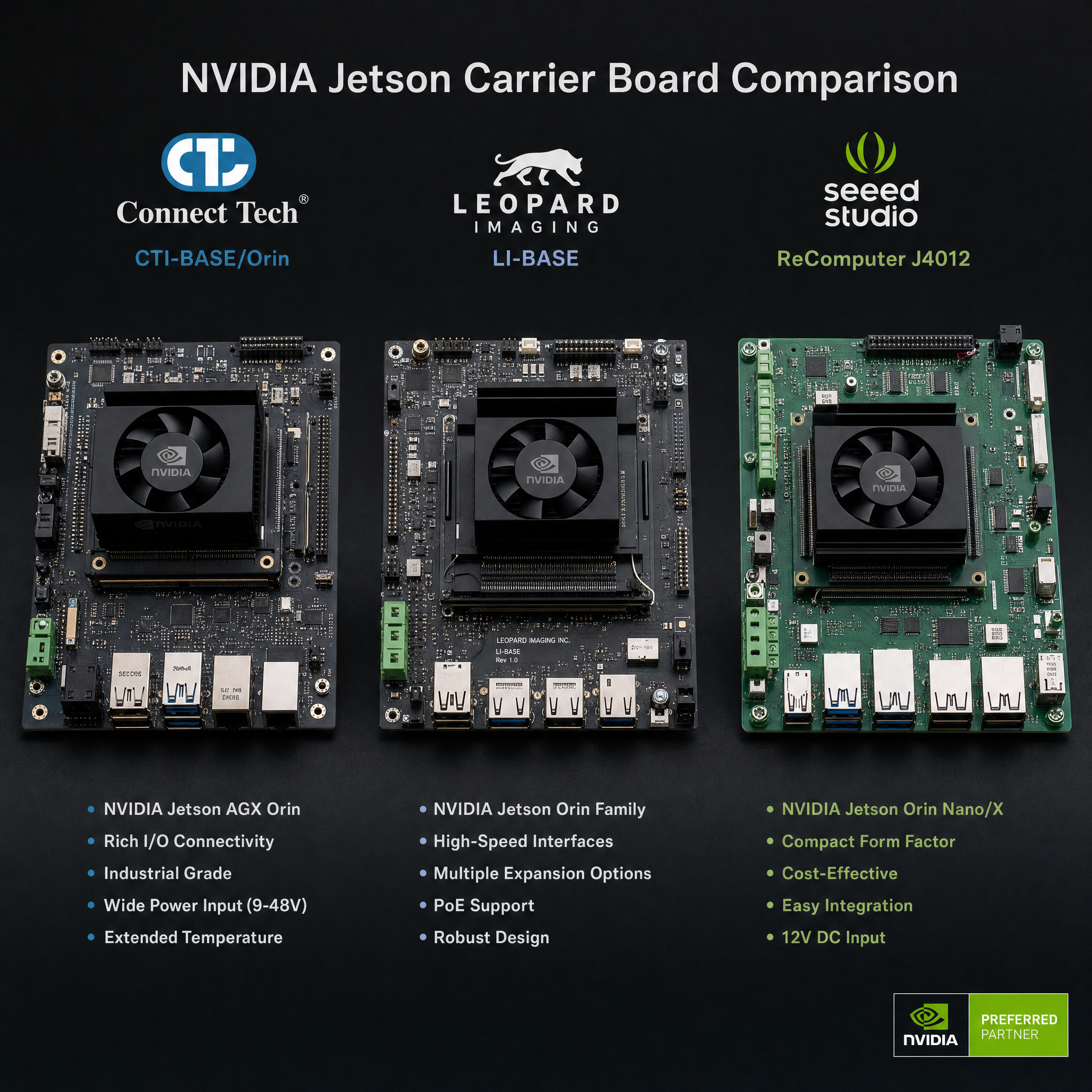
Third-party NVIDIA Jetson carrier board manufacturers compared for edge AI
Choosing a third-party Jetson carrier board involves more than checking the connector pinout. The BSP quality, camera driver support, and the vendor’s JetPack update cadence determine whether the board saves you time or costs you weeks of bring-up. This post compares the main Jetson carrier board manufacturers for edge AI applications, what they make, what their BSP actually covers, and which fits which project.
Key Insights
- BSP quality varies more than hardware quality, a board with poor or unmaintained BSP support costs you bring-up time even if the hardware is solid
- GMSL2 requires a specific vendor shortlist, Leopard Imaging and Tier IV have the most mature GMSL2 support; most other vendors don’t support GMSL2 at all
- “BSP available” in the product listing means nothing without specifics, ask which sensors are validated, which JetPack version, and when it was last updated
- Seeed Studio reComputer is the price leader, but BSP depth is lighter, fine for evaluation, not for a production camera pipeline
- Custom carrier boards are a different conversation, third-party boards get you hardware faster, but you’ll still likely need bring-up help for camera drivers
What “carrier board” actually means
A Jetson carrier board hosts the Jetson System-on-Module (SoM). The SoM contains the SoC, RAM, and eMMC. The carrier board provides power, USB, PCIe, camera interfaces, and all the connectors your product needs. NVIDIA sells devkits with their own carrier boards; third-party manufacturers sell alternative carriers with different form factors, connector configurations, and camera support.
The critical distinction for software teams: the carrier board manufacturer is responsible for the BSP that makes the hardware work with JetPack. NVIDIA’s BSP covers the devkit. Everything else is the vendor’s responsibility.
How do you choose a Jetson carrier board?
Work through four questions in order, they eliminate most of the market quickly:
- How many cameras, and over what interface? More than 2 cameras or cable runs beyond ~30cm means GMSL2 (or FPD-Link), that alone narrows you to Leopard Imaging, Tier IV, or DesignCore. Direct CSI at short range keeps everyone in play.
- What environment? Industrial temperature range, vibration, or an enclosure requirement points to Connect Tech, Forecr, or Tier IV. Bench and indoor prototypes can use anything.
- Who owns the BSP? If nobody on the team wants to maintain device trees and JetPack migrations, pay for vendor BSP quality (Connect Tech’s update cadence is the benchmark). If you have embedded Linux capacity in-house, a cheaper board with a basic BSP (Auvidea) is a legitimate trade.
- Prototype or production? Seeed reComputer is fine to start development this week, but validate your production camera path on the production board, not the prototype one.
If your form factor, connector, or interface requirements survive none of the off-the-shelf options, that is the custom carrier board conversation.
The main manufacturers
Connect Tech, Best overall BSP track record
Connect Tech (CTI) has been making Jetson carrier boards longer than most. Their Rogue and Boson series for Jetson Orin are well-maintained, and their BSP packages (CTI board support packages) are updated with each major JetPack release.
| Modules supported | Orin NX, Orin Nano, AGX Orin |
| Notable boards | Rogue (industrial compact), Boson (full-size industrial), Quill |
| GMSL2 support | Via FRAMOS adapter integration; not native on most boards |
| BSP quality | High, maintained against current L4T, documented |
| Price tier | Mid ($400–$900) |
| Best for | Industrial deployments, teams that need a maintained BSP and don’t want to manage it themselves |
CTI’s BSP support is their strongest differentiator. When JetPack 6 shipped, CTI had updated BSPs available within weeks. If you’re building on Orin and want a third-party board without a BSP headache, CTI is the safest choice for non-GMSL2 applications.
Leopard Imaging, Best for camera-forward designs
Leopard Imaging focuses specifically on camera modules and carrier boards. Their boards are designed around camera connectivity, and their BSP packages include camera drivers for their sensor modules, which is unusual in this market.
| Modules supported | Orin NX, Orin Nano, AGX Orin |
| Notable boards | LI-ORIN-NANO-SD, LI-Orin-GMSL2-4CAM, LI-Orin-GMSL2-8CAM |
| GMSL2 support | Native, GMSL2-focused boards with MAX9296A/MAX96724 |
| BSP quality | High for their validated sensors; limited outside their sensor ecosystem |
| Price tier | Mid to high ($500–$1,500) |
| Best for | Projects requiring GMSL2 cameras or validated ISP pipelines for specific sensors |
If your design requires GMSL2 cameras, Leopard Imaging should be your first evaluation. Their GMSL2 carrier boards ship with driver support for IMX390 and other sensors in their lineup. The tradeoff: their BSP works well for their sensors but requires more work to add sensors outside their catalog.
FRAMOS, Best sensor ecosystem depth
FRAMOS focuses on camera modules and adapter boards rather than full carrier boards. Their FSA-FPA adapter board system adds camera connectivity to existing Jetson carriers. Their value is the FRAMOS Sensor Driver Package, which includes drivers for a wide range of Sony, onsemi, and Omnivision sensors.
| Modules supported | Orin NX, Orin Nano, AGX Orin (via adapter to other carriers) |
| Notable products | FPA-4.A-X1 adapter boards, FSA-FPA camera modules |
| GMSL2 support | Limited, CSI focus |
| BSP quality | High within their sensor ecosystem |
| Price tier | Mid ($300–$800 for adapter + module) |
| Best for | Teams with an existing carrier board who need validated drivers for FRAMOS sensor modules |
FRAMOS is a good choice if you’ve already selected a carrier board and need drivers for a specific sensor module that FRAMOS supports. Less useful if you’re starting from scratch and need a full board selection.
Tier IV, Best for automotive and GMSL2
Tier IV builds Jetson carrier boards for automotive applications. Their IE-4000 is an automotive-grade carrier with native GMSL2 support, designed for multi-camera autonomous driving setups.
| Modules supported | AGX Orin primarily |
| Notable boards | IE-4000 (automotive, GMSL2) |
| GMSL2 support | Native, up to 8 GMSL2 cameras with MAX96724 |
| BSP quality | High, maintained for automotive reliability requirements |
| Price tier | High ($2,000–$3,000+) |
| Best for | Automotive, robotics, or industrial applications requiring high GMSL2 camera counts and long-term support |
If you’re building an autonomous vehicle or robotic perception system with multiple GMSL2 cameras and need board-level support you can count on for years, Tier IV is worth the premium. For most edge AI applications without those requirements, it’s overspecced.
Auvidea, Low-cost industrial option
Auvidea makes a range of Jetson carrier boards at competitive price points, particularly for the B369 and B386 targeting Orin. BSP support is more basic than CTI or Leopard.
| Modules supported | Orin NX, Orin Nano, AGX Orin |
| Notable boards | B369, B386, B203 |
| GMSL2 support | Limited, primarily CSI |
| BSP quality | Basic, base L4T BSP; less camera-driver depth |
| Price tier | Low-mid ($200–$600) |
| Best for | Teams comfortable managing their own BSP who want a lower hardware cost |
Auvidea boards work well as hardware platforms, but expect more BSP self-management. Good choice if your team has embedded Linux experience and wants to own the BSP work.
Seeed Studio reComputer, Best entry-level option
Seeed Studio’s reComputer J series (J3010, J4011, J4012) are accessible Jetson Orin boards aimed at developers and prototype-stage teams. Lower price, lighter BSP depth.
| Modules supported | Orin NX, Orin Nano |
| Notable boards | reComputer J3010, J4011, J4012 |
| GMSL2 support | None |
| BSP quality | Basic, community support, less enterprise-grade maintenance |
| Price tier | Low ($150–$400) |
| Best for | Prototyping, evaluation, early development before production board selection |
The reComputer series is fine for getting Jetson development started. Don’t plan a production camera pipeline around it without verifying that your specific camera is supported.
DesignCore (D3 Embedded), Best for high camera counts
D3 Embedded’s DesignCore line targets rugged, multi-camera perception systems, including 8-camera GMSL2 configurations on Orin. D3 also offers integration support alongside the boards, which is worth factoring into the purchase path.
| Modules supported | Orin NX, AGX Orin |
| Notable boards | DesignCore rugged GMSL2 carriers (up to 8 cameras) |
| GMSL2 support | Native, high camera counts |
| BSP quality | High for their validated camera kits |
| Price tier | High (quote-based) |
| Best for | Robotics/perception products needing many synchronized GMSL2 cameras with integration support behind them |
Forecr, Industrial catalog alternative
Forecr (Mist Elektronik) ships the DSBOARD line of industrial Jetson carriers with enclosures, and publishes flashing guides and BSP packages per JetPack release, better documentation discipline than most vendors in its price range.
| Modules supported | Orin NX, Orin Nano, AGX Orin |
| Notable boards | DSBOARD-ORNX, DSBOARD-AGX |
| GMSL2 support | Limited, primarily CSI/USB |
| BSP quality | Mid, documented, regular updates |
| Price tier | Low-mid |
| Best for | Industrial deployments on a budget that still want documented BSPs and enclosures |
Comparison table
| Vendor | GMSL2 | BSP quality | JetPack updates | Price tier | Best use case |
|---|---|---|---|---|---|
| Connect Tech | Via adapter | ★★★★★ | Fast | $$$ | Industrial non-GMSL2 |
| Leopard Imaging | Native | ★★★★☆ | Regular | $$$ | GMSL2, validated ISP |
| FRAMOS | No | ★★★★☆ | Regular | $$$ | Sensor module ecosystem |
| Tier IV | Native | ★★★★★ | Automotive cadence | $$$$$ | Automotive, multi-GMSL2 |
| Auvidea | Limited | ★★★☆☆ | Irregular | $$ | Teams owning BSP |
| Seeed reComputer | No | ★★☆☆☆ | Community | $ | Prototyping |
| DesignCore (D3) | Native, 8-cam | ★★★★☆ | With services | $$$$ | Multi-camera perception |
| Forecr | Limited | ★★★☆☆ | Regular | $$ | Industrial on a budget |
Questions to ask any vendor before buying
“Which sensors is your BSP validated with?” The answer should name specific sensors (IMX390, IMX219, etc.) with JetPack version numbers. If the answer is vague, the BSP validation is likely equally vague.
“What JetPack version is your BSP currently validated on?” If the answer is JetPack 5 and you’re targeting JetPack 6, you have a migration project.
“How are BSP updates delivered when JetPack is updated?” Good vendors have a release cadence. Others ship one BSP and stop.
“Do you provide device tree source for your camera configurations?” If you need to modify camera settings (different sensor, different mode), you need DTS source. Binary-only BSPs are a lock-in risk.
“What is your support channel for bring-up issues?” Forum, Slack, email, or phone, and what’s the typical response time.
Custom carrier boards vs. third-party boards
Third-party carrier boards get you hardware faster. But even with a third-party board, you often need bring-up help for:
- Camera sensors not in the vendor’s supported list
- Custom peripheral integration (PCIe devices, specific UART configs)
- JetPack migration when the vendor’s BSP hasn’t been updated
A custom carrier board is the right call when your product has specific form factor, connector, or interface requirements that no off-the-shelf board matches. The hardware design cost is typically $50k–$150k depending on complexity; the BSP bring-up cost is additional.
From our own bring-up work, the BSP-quality gap between vendors is wider than the spec sheets suggest. The recurring red flags: a vendor BSP still pinned one or two JetPack majors behind current, device tree shipped as binary only (you cannot add a sensor without vendor involvement), and flash scripts that assume the devkit layout and silently fail on the vendor’s own board. Any of these turns a “supported” board into a rescue project, ask the questions above before the purchase order, not after.
Once you’ve selected a board, third-party or custom, the bring-up work starts. If you’re working on a GMSL2 camera pipeline or need camera driver development for sensors outside your vendor’s supported list, ProventusNova handles Jetson camera bring-up from driver to verified frame capture. For GMSL2-specific bring-up, see GMSL2 camera bring-up on Jetson Orin. And if you would rather hand off the vendor evaluation itself, sample sourcing, spec matching, and ODM negotiation, that is what our hardware sourcing service does.
FAQ
Which is the best Jetson carrier board manufacturer?
It depends on your camera requirements. Connect Tech and Leopard Imaging have the strongest BSP support. For GMSL2 cameras, Leopard Imaging and Tier IV are the most mature options. For a lower price point with acceptable BSP quality, Connect Tech’s Rogue or Seeed Studio’s reComputer series are worth evaluating.
Do third-party Jetson carrier boards include a BSP?
Some do, most don’t, at least not a properly maintained one. Connect Tech, Leopard Imaging, FRAMOS, and Tier IV all provide BSP packages maintained against current JetPack releases. Auvidea and generic board-only vendors typically provide a base L4T BSP without camera drivers or custom peripheral support. Always ask which JetPack version the BSP was last validated on.
What is the difference between a Jetson carrier board and a custom carrier board?
A third-party carrier board is an off-the-shelf board you buy from a manufacturer. A custom carrier board is one your team designs specifically for your product. Custom boards have better fit for your exact connector and peripheral requirements but require BSP bring-up work. Third-party boards trade flexibility for faster time-to-hardware, but still often require BSP bring-up for camera drivers.
Which Jetson carrier boards support GMSL2 cameras?
Leopard Imaging (LI-Orin-GMSL2 series), Tier IV (IE-4000), DesignCore/D3 Embedded (rugged carriers up to 8 GMSL2 cameras), and Connect Tech (some configurations with FRAMOS adapters) have documented GMSL2 support with BSPs. If GMSL2 is a requirement, start with Leopard Imaging, Tier IV, or DesignCore.
How do I choose between Jetson carrier board vendors?
Four questions in order: camera count/interface (>2 cameras or long cable runs → GMSL2 vendors), environment (industrial → Connect Tech, Forecr, Tier IV), BSP ownership (no in-house embedded Linux capacity → pay for BSP quality), and prototype vs production (validate the production camera path on the production board).
How much does a Jetson Orin carrier board cost?
Entry-level boards (Seeed Studio reComputer, some Auvidea) run $150–$400. Mid-tier boards with solid BSP support (Connect Tech Rogue, Leopard Imaging) are typically $400–$900. Industrial-grade and GMSL2-focused boards (Tier IV IE-4000, Connect Tech Boson) can be $1,000–$3,000+.
Relevant Services
NVIDIA Jetson Expert Support
Stuck on a Jetson bring-up?
We've debugged this failure mode before. BSP, device tree, camera pipelines, OTA, most blockers clear in the first session. No long retainers. No guessing.
Frequently Asked Questions
Which is the best Jetson carrier board manufacturer?
It depends on your camera requirements. Connect Tech and Leopard Imaging have the strongest BSP support. For GMSL2 cameras, Leopard Imaging and Tier IV are the most mature options. For a lower price point with acceptable BSP quality, Connect Tech's Rogue or Seeed Studio's reComputer series are worth evaluating.
Do third-party Jetson carrier boards include a BSP?
Some do, most don't, at least not a properly maintained one. Connect Tech, Leopard Imaging, FRAMOS, and Tier IV all provide BSP packages maintained against current JetPack releases. Auvidea and generic board-only vendors typically provide a base L4T BSP without camera drivers or custom peripheral support. Always ask which JetPack version the BSP was last validated on.
What is the difference between a Jetson carrier board and a custom carrier board?
A third-party carrier board is an off-the-shelf board you buy from a manufacturer. A custom carrier board is one your team designs (or has designed) specifically for your product. Custom boards have better fit for your exact connector and peripheral requirements but require BSP bring-up work. Third-party boards trade flexibility for faster time-to-hardware, but still often require BSP bring-up for camera drivers.
Which Jetson carrier boards support GMSL2 cameras?
Leopard Imaging (LI-Orin-GMSL2 series), Tier IV (IE-4000), DesignCore/D3 Embedded (rugged carriers up to 8 GMSL2 cameras), and Connect Tech (some configurations with FRAMOS adapters) have documented GMSL2 support with BSPs. Most other carrier board vendors support standard CSI cameras but not GMSL2. If GMSL2 is a requirement, start with Leopard Imaging, Tier IV, or DesignCore.
How do I choose between Jetson carrier board vendors?
Answer four questions in order: camera count and interface (more than 2 cameras or long cable runs means GMSL2, Leopard Imaging, Tier IV, or DesignCore), environment (industrial temperature/vibration points to Connect Tech, Forecr, or Tier IV), BSP ownership (pay for vendor BSP quality unless you have in-house embedded Linux capacity), and prototype vs production (Seeed reComputer is fine to start, but validate the production camera path on the production board).
How much does a Jetson Orin carrier board cost?
Entry-level boards (Seeed Studio reComputer, some Auvidea) run $150–$400. Mid-tier boards with solid BSP support (Connect Tech Rogue, Leopard Imaging LI-Orin-NANO-SD) are typically $400–$900. Industrial-grade and GMSL2-focused boards (Tier IV IE-4000, Connect Tech Boson) can be $1,000–$3,000+. The BSP and camera support that comes with the board is often the more important cost variable than the hardware price.
Written by
Andrés CamposCo-Founder & CTO · ProventusNova
8 years deep in embedded systems, from underwater ROVs to edge AI. Andrés leads every technical delivery personally.
Connect on LinkedInRelated Articles
Choosing a GMSL2 carrier board for Jetson Orin: what to check
How to evaluate a GMSL2 carrier board for Jetson Orin before you buy. Port count, deserializer chipset, BSP support, and the questions most vendors don't.
CTI Carrier Board Yocto Layer: Two-Tier Wrapper Pattern
How to wrap Connect Tech's meta-cti Yocto layer with your own distro layer to add camera overlay DTBs without forking the vendor's BSP.
Custom Carrier Board Not Booting on Jetson Orin: Fixed in One Session
Custom carrier board not booting on Jetson Orin? Farmhand AI's board booted in one session. Three BSP parameters cause most Jetson bring-up failures.
Ethernet PHY bring-up on Jetson Orin: DP83867 and EQOS RGMII
TI DP83867 PHY not working on Jetson Orin custom carrier board? Here are the EQOS RGMII timing, MDIO pinmux, and device tree configuration issues that.