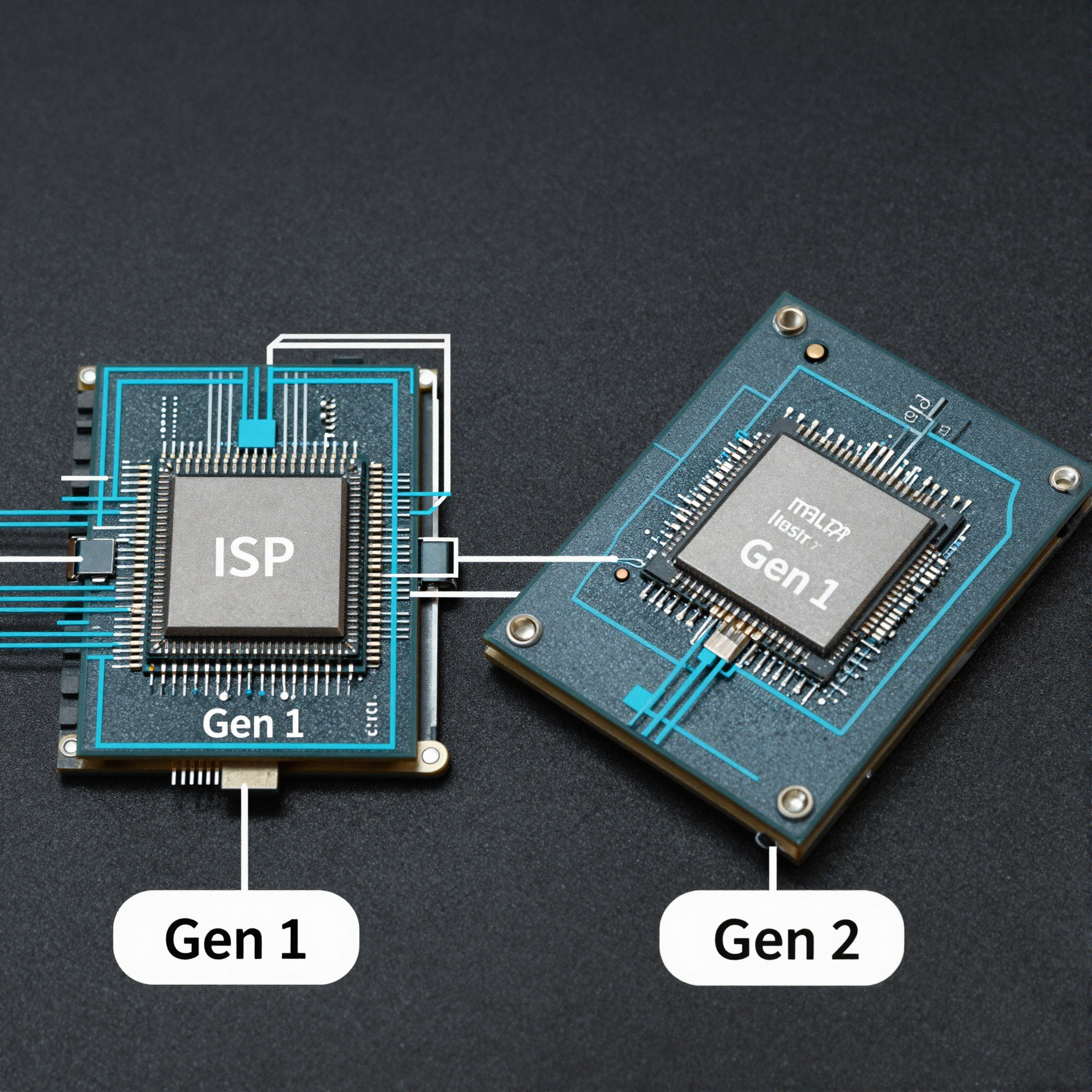
ISP differences between Genio 510/700 and Genio 520/720
The ISP (Image Signal Processor) is one of the most significant hardware changes between the first-generation Genio platforms (510/700) and the second-generation (520/720). If your product depends on camera input, the ISP generation affects MIPI lane configuration, virtual channel support, 3A pipeline depth, and which NDA BSP components you need to configure.
Key Insights
- Genio 510/700 use ISP Gen 1, up to 2 concurrent camera inputs, no virtual channel support
- Genio 520/720 use ISP Gen 2, up to 4 concurrent camera inputs, virtual channel support, improved 3A
- 520 and 720 share the same ISP, camera tuning files and libcamera pipeline handlers transfer directly
- Camera sensor drivers are largely portable, but ISP pipeline configuration (libcamera handler, tuning JSON) must be updated when moving between ISP generations
- For time-of-flight sensors or any camera using MIPI CSI-2 virtual channels, Genio 520/720 is required
What changed between ISP Gen 1 and Gen 2?
| Feature | Genio 510/700 (Gen 1 ISP) | Genio 520/720 (Gen 2 ISP) |
|---|---|---|
| Max concurrent camera inputs | 2 | 4 |
| MIPI CSI-2 virtual channels | Not supported | Supported (up to VC3) |
| Max input resolution | 16 MP | 32 MP |
| Max framerate at 4K | 30 fps | 60 fps |
| 3A algorithms | Gen 1 (basic AE/AF/AWB) | Gen 2 (improved convergence) |
| libcamera pipeline handler | mtk-isi-gen1 | mtk-isi-gen2 |
| ISP tuning file format | JSON v1 | JSON v2 |
| NDA BSP layer | meta-mediatek-bsp-private (Gen 1) | meta-mediatek-bsp-private (Gen 2) |
The pipeline handler difference is the practical blocker when porting a camera design between generations. The libcamera IPA (Image Processing Algorithm) modules are separate binary blobs in the NDA BSP, one per ISP generation.
How does the MIPI CSI-2 configuration differ?
On Genio 510/700 (Gen 1), the MIPI CSI-2 receiver accepts up to 4 lanes per port but does not implement virtual channel demultiplexing in hardware. Each physical port maps to one sensor.
On Genio 520/720 (Gen 2), the CSI-2 receiver implements virtual channel (VC) demultiplexing. A single physical MIPI port with 4 lanes can carry streams from up to 4 virtual channels simultaneously. This enables:
- Time-of-flight sensors that output IR and depth on separate VCs
- Camera modules with embedded metadata on VC1
- Multi-exposure HDR sensors that send short and long exposures on separate VCs
The device tree binding also changes. On Gen 2, each virtual channel is a separate v4l2-subdev node with a vc-id property.
Example device tree fragment for a Gen 2 dual-VC sensor:
&mipi_csi0 {
    sensor@0 {
        compatible = "vendor,sensor-name";
        reg = <0x36>;
        port {
            sensor_out: endpoint {
                clock-lanes = <0>;
                data-lanes = <1 2 3 4>;
                link-frequencies = /bits/ 64 <800000000>;
            };
        };
    };
};

&seninf {
    ports {
        port@0 {
            vc0: endpoint@0 {
                vc-id = <0>;
                remote-endpoint = <&sensor_out>;
            };
            vc1: endpoint@1 {
                vc-id = <1>;
                remote-endpoint = <&sensor_out>;
            };
        };
    };
};
This device tree syntax is not valid on Gen 1 ISP, the seninf binding does not support per-VC endpoints.
What stays the same between platforms?
The sensor driver itself, the kernel module that controls the image sensor over I2C, is largely platform-independent. It configures the sensor’s register map, controls exposure and gain, and sets the MIPI output format. This part of the code does not interact with the ISP directly.
What must change when moving from Gen 1 to Gen 2:
- ISP pipeline handler: The libcamera
IPAbinary and pipeline handler source are separate per ISP generation. Use the Gen 2 handler from the NDA BSP. - Tuning JSON: The JSON schema changed between generations. A Gen 1 tuning file will not parse correctly on Gen 2.
- Device tree: MIPI CSI-2 bindings changed, particularly if using virtual channels.
- seninf node: The sensor interface node binding differs between Gen 1 and Gen 2.
The sensor characterization data (optical center, noise model, lens shading) carries over, but it needs to be re-expressed in the Gen 2 JSON format.
Which platform should you choose for a new camera design?
For any new product that includes a camera:
- Genio 520: cost-optimized, Gen 2 ISP, good for 1-2 sensors at moderate resolution
- Genio 720: performance, Gen 2 ISP, up to 4 sensors, suitable for multi-camera AI vision systems
- Genio 1200: maximum compute, Gen 2 ISP, dual MDLA for processing multiple camera streams through AI inference simultaneously
Avoid designing new products on Genio 510/700 if your camera requirements include virtual channels, 4K at 60fps, or more than 2 simultaneous inputs. For the full device tree and kernel driver setup for MIPI CSI-2, see MIPI CSI camera driver setup on MediaTek Genio.
Working on camera integration on MediaTek Genio and need help with ISP bring-up, sensor driver porting, or libcamera configuration? ProventusNova specializes in embedded Linux and camera software on Genio. See our CSI camera driver service or get in touch.
Relevant Services
MediaTek Genio Expert Support
Building on MediaTek Genio?
BSP bring-up, GStreamer pipelines, NeuroPilot integration, we've shipped it. Get unblocked fast. One call to scope it, fixed bid to deliver it.
Frequently Asked Questions
What is the main ISP difference between Genio 700 and Genio 720?
Genio 720 (MT8395S) has a more capable ISP pipeline with support for up to 4 concurrent camera inputs vs 2 on Genio 700, improved 3A algorithms (auto-exposure, auto-focus, auto-white-balance), and virtual channel support on MIPI CSI-2. The sensor driver tuning files and libcamera pipeline handlers are different between the two platforms, a Genio 700 camera configuration will not work on Genio 720 without modification.
Do Genio 520 and Genio 720 share the same ISP?
Yes. Genio 520 (MT8371) and Genio 720 (MT8395S) use the same ISP generation (Gen 2). The ISP pipeline depth, virtual channel support, and libcamera pipeline handler are identical. The difference is CPU/GPU/NPU compute, not ISP capability. Camera tuning files developed for Genio 520 transfer directly to Genio 720.
Does Genio 510 support MIPI CSI virtual channels?
No. Genio 510 (MT8370) does not support MIPI CSI-2 virtual channels in the Gen 1 ISP. Virtual channel support was introduced in Genio 520/720 (Gen 2 ISP). If your camera outputs multiple streams over virtual channels (e.g., a time-of-flight sensor with IR and depth on VC0 and VC1), you need Genio 520 or 720.
Can I use the same camera sensor driver on both Genio 700 and Genio 720?
The sensor driver itself (i2c register map, timing, exposure control) is typically the same, it talks to the sensor hardware. The difference is the ISP pipeline configuration. The libcamera pipeline handler, tuning .json file, and any 3A algorithm parameters must be updated for the Gen 2 ISP. MediaTek provides separate ISP pipeline handlers for Gen 1 and Gen 2 in the NDA BSP.
What is the maximum resolution and framerate supported by the Genio 720 ISP?
The Genio 720 ISP supports up to 32 MP input resolution and up to 60fps at 4K. For machine vision workloads, it supports concurrent inputs from multiple sensors up to its total bandwidth budget. Exact limits depend on pixel format, number of active sensors, and whether the ISP pipeline is running in inline or offline mode.
Written by
Andrés CamposCo-Founder & CTO · ProventusNova
8 years deep in embedded systems, from underwater ROVs to edge AI. Andrés leads every technical delivery personally.
Connect on LinkedInRelated Articles
MIPI CSI camera driver setup on MediaTek Genio
How to set up a MIPI CSI-2 camera on MediaTek Genio: device tree, sensor driver, seninf, V4L2 pipeline, and capturing frames with GStreamer.
Jailhouse hypervisor on MediaTek Genio: bare-metal isolation on Linux
Jailhouse hypervisor on MediaTek Genio 720: cell config, GIC addresses, required kernel patches, MTK vendor config, and IVSHMEM communication.
MediaTek Genio boot flow: from power-on to Linux
MediaTek Genio boot sequence: TF-A, OP-TEE, U-Boot through Linux. Covers partition layout, boot_conf overlay loading, and strapping for custom carrier boards.
MediaTek Genio for computer vision: a practical guide
Build a computer vision pipeline on MediaTek Genio. Camera capture, GStreamer, OpenCV, TFLite NPU inference, and end-to-end object detection pipeline examples.