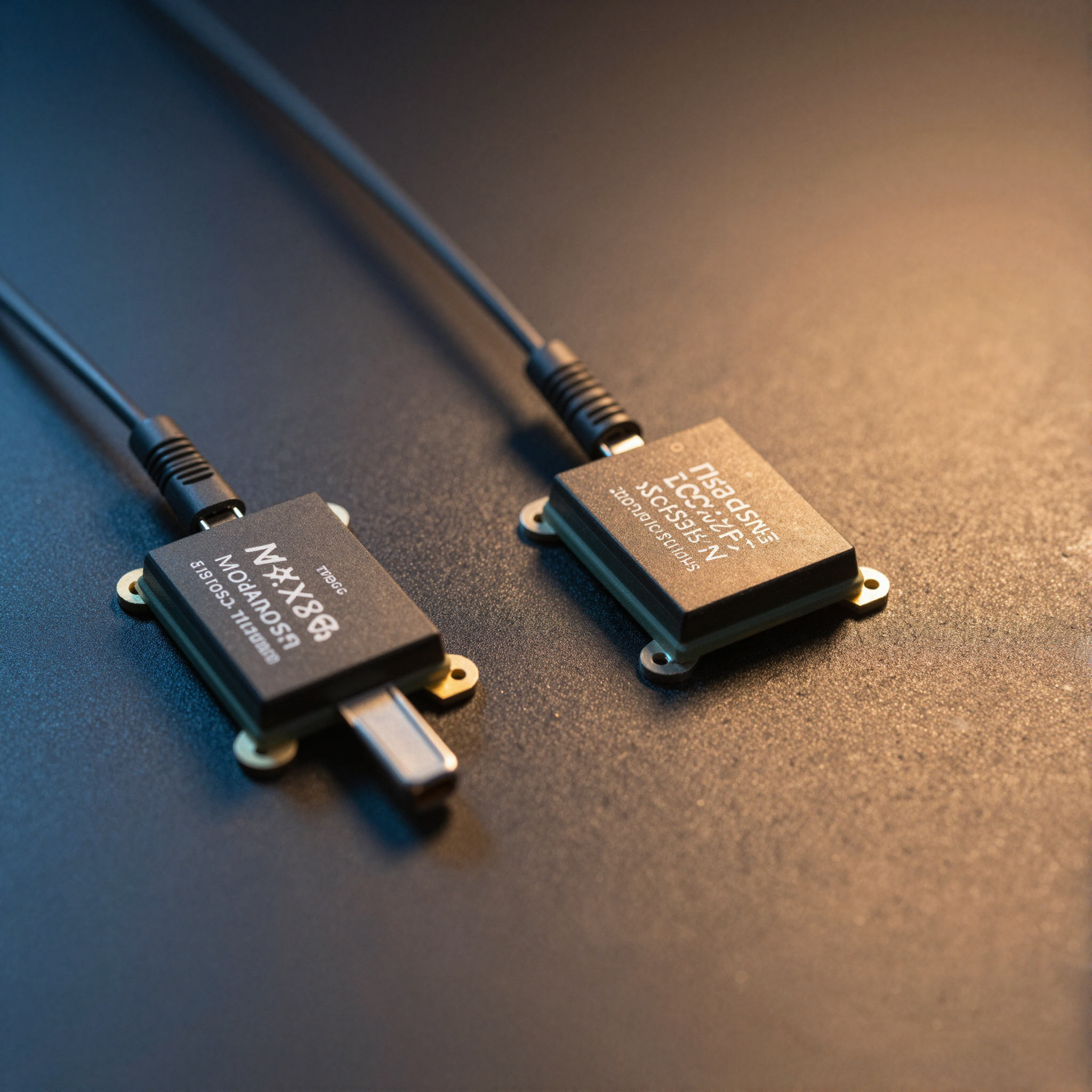
GMSL2 vs FPD-Link III for Jetson: SerDes comparison
Engineers choosing a SerDes technology for a Jetson camera system typically come down to GMSL2 (Analog Devices MAX9295/MAX9296) or FPD-Link III (TI DS90UB953/DS90UB954). Both solve the same problem, transporting MIPI CSI-2 video from a remote camera over coaxial cable, but they differ in driver support, data rate, chip ecosystem, and the amount of custom kernel work required to bring them up on Jetson.
Key Insights
- GMSL2 has NVIDIA reference drivers in L4T; FPD-Link III does not, this single factor dominates the decision for new Jetson designs
- Both support up to 15m cable distance, power over coax, and hardware frame sync
- GMSL2 runs at 6 Gbps per link; FPD-Link III at 4.16 Gbps, GMSL2 supports higher-resolution or higher-frame-rate sensors
- The image sensor (IMX390, OX03C, etc.) is SerDes-agnostic, camera module vendors offer both variants
- Mixing both in one system is possible but requires two separate deserializers and two separate NVCSI connections
Side-by-side comparison
| GMSL2 | FPD-Link III | |
|---|---|---|
| Primary chipmaker | Analog Devices (was Maxim) | Texas Instruments |
| Common serializer | MAX9295A | DS90UB953-Q1 |
| Common deserializer | MAX9296A (dual), MAX96724 (quad) | DS90UB954-Q1 (quad) |
| Link data rate | Up to 6 Gbps | Up to 4.16 Gbps |
| Cable type | Coax (RG-6 typical) | Coax or shielded twisted pair |
| Max cable distance | 15m | 15m |
| Power over coax | Yes | Yes |
| Back channel (I2C/GPIO) | Yes, GMSL2 control channel | Yes, FPD-Link III back channel |
| Frame sync | FSYNC via control channel | SYNC via back channel |
| Virtual channels | Up to 4 VC per deserializer output | Up to 4 VC per deserializer output |
| NVIDIA L4T drivers | Reference drivers included | Not included, custom driver required |
| Automotive qualification | AEC-Q100 (MAX9295A) | AEC-Q100 (DS90UB953-Q1) |
| Common use in Jetson | Very common, NVIDIA reference design | Less common, requires BSP work |
Why GMSL2 is the default choice for Jetson
NVIDIA’s L4T kernel source includes complete reference drivers for the MAX9295A serializer and MAX9296A/MAX96724 deserializer. These drivers handle:
- Link training and lock detection
- I2C tunnel and address reassignment
- MIPI output configuration
- FSYNC routing for multi-camera sync
- Integration with the tegra-camera-platform framework
This means GMSL2 bring-up on Jetson Orin starts from a working reference point. You write a sensor driver for your specific image sensor, the SerDes layer is already handled.
FPD-Link III has no equivalent in L4T. Bringing up a DS90UB954 on Jetson means writing the deserializer driver from scratch: I2C tunnel management, link lock handling, MIPI output configuration, and tegra-camera-platform integration. This is a real engineering project, typically 2–4 weeks of kernel driver work, before you even get to sensor bringup.
Unless your camera module vendor ships a Jetson-specific BSP with FPD-Link III support already integrated, the choice effectively is: use GMSL2 and start from NVIDIA’s reference, or use FPD-Link III and write the base driver yourself.
Data rate: when 6 Gbps vs 4.16 Gbps matters
At typical camera resolutions and frame rates, FPD-Link III’s 4.16 Gbps is sufficient:
- 1920×1080 @ 30fps, RAW12 → ~750 Mbps → well within both limits
- 1920×1080 @ 60fps, RAW12 → ~1.5 Gbps → within both limits
- 3840×2160 (4K) @ 30fps, RAW12 → ~3 Gbps → within both, but tight for FPD-Link III with overhead
Where GMSL2’s 6 Gbps headroom matters: high-speed sensors (120fps+), wide-format sensors (>3840 wide), or sensors with high bit depth (RAW16) where the raw data rate approaches the link capacity. For standard automotive camera resolutions (1080p at 30fps), data rate is not a differentiator.
Multi-camera configurations
Both SerDes systems support aggregating multiple cameras onto a single MIPI output using virtual channels, but the topology differs.
GMSL2 multi-camera topology:
Camera 0 → MAX9295A → MAX9296A (dual-link) → MIPI VC0+VC1 → Jetson NVCSI
Camera 1 → MAX9295A ↗

Camera 0-3 → MAX9295A × 4 → MAX96724 (quad-link) → MIPI VC0-VC3 → Jetson NVCSI
FPD-Link III multi-camera topology:
Camera 0-3 → DS90UB953 × 4 → DS90UB960 (quad-link) → MIPI VC0-VC3 → Jetson NVCSI
The DS90UB960 supports 4 input ports like the MAX96724. Both can aggregate 4 cameras onto a single MIPI link. The wiring and bring-up sequence are similar; the difference is the driver layer.
Power over coax: powering the camera from the host
Both GMSL2 and FPD-Link III support Power over Coax (PoC). The deserializer injects DC voltage onto the coaxial cable, and the serializer (on the camera board) has a PoC regulator that extracts it.
Practical limits:
- MAX9296A PoC: up to 800mA at 8.6V nominal (varies by operating conditions), sufficient for a camera module and serializer with a small image sensor
- DS90UB954 PoC: similar current capability, check the specific revision datasheet
Neither is suitable for powering high-power cameras (thermal IR sensors, high-frame-rate sensors with significant analog front-end power). For those, run a separate power conductor alongside the coax or use a dedicated power injection board.
Choosing between GMSL2 and FPD-Link III
Use GMSL2 when:
- Your target platform is NVIDIA Jetson (Orin NX, Orin AGX)
- You want to start from NVIDIA’s reference drivers
- Your camera module vendor offers GMSL2 variants
- You need the extra data rate headroom for high-resolution sensors
- You are not committed to a specific automotive platform that mandates FPD-Link III
Use FPD-Link III when:
- Your existing platform ecosystem (other SOCs, automotive ECU) is already FPD-Link III
- Your camera module vendor only offers FPD-Link III and you cannot switch
- You have a BSP vendor who provides FPD-Link III Jetson support
- You’re integrating into an automotive ADAS platform where TI’s ecosystem is standard
For GMSL2 bring-up on Jetson Orin from scratch, the full sequence is in GMSL2 camera bring-up on Jetson Orin: MAX9295/MAX9296 setup. For the SerDes architecture overview, see GMSL2 SerDes explained: MAX9295 and MAX9296 for Jetson bring-up.
If you need a custom GMSL2 or FPD-Link III bring-up on a custom carrier board or with a non-reference sensor, the GMSL camera driver development service covers what a scoped engagement typically involves.
The MAX9295A and MAX9296A datasheets with full register maps are on the Analog Devices product pages. The DS90UB953 and DS90UB954 datasheets are on the TI product pages.
NVIDIA Jetson Expert Support
Stuck on a Jetson bring-up?
We've debugged this failure mode before. BSP, device tree, camera pipelines, OTA, most blockers clear in the first session. No long retainers. No guessing.
Frequently Asked Questions
What is the main difference between GMSL2 and FPD-Link III?
GMSL2 (Maxim/Analog Devices ecosystem: MAX9295/MAX9296) and FPD-Link III (TI ecosystem: DS90UB953/DS90UB954) both transport MIPI CSI-2 video over coaxial cable. The key differences: GMSL2 runs at up to 6 Gbps per link vs. FPD-Link III at 4.16 Gbps; GMSL2 has better NVIDIA Jetson driver support in L4T; FPD-Link III is more common in automotive ADAS and has broader chip availability. For new Jetson designs, GMSL2 is the lower-risk choice due to the NVIDIA reference drivers.
Does NVIDIA provide reference drivers for FPD-Link III on Jetson?
NVIDIA does not include FPD-Link III (TI DS90UBxxx) reference drivers in the standard L4T release. NVIDIA's camera driver framework is built around the MAX9295/MAX9296 SerDes. FPD-Link III bring-up on Jetson requires writing a custom kernel driver for the deserializer (DS90UB954 or similar), which is a significant additional engineering effort. Some third-party carrier board vendors provide FPD-Link III support as BSP add-ons.
Which SerDes has better cable distance: GMSL2 or FPD-Link III?
Both support up to 15 meters over standard automotive coaxial cable (RG-6 or equivalent). GMSL2 is rated to 15m at 6 Gbps. FPD-Link III is rated to 15m at 4.16 Gbps. In practice, cable quality and connector quality matter more than the rated distance, a high-quality RG-6 cable will perform better than a budget coax regardless of the SerDes. Beyond 15m, both technologies degrade; neither is rated for longer runs without signal conditioning.
Does FPD-Link III support power over coax (PoC) like GMSL2?
Yes. Both GMSL2 and FPD-Link III support Power over Coax (PoC), delivering power from the deserializer to the camera module over the same coaxial cable used for video. The PoC voltage and current specifications differ slightly between the two ecosystems, check the specific chip datasheet (MAX9296A vs DS90UB954) for current delivery limits. Both are suitable for powering a camera module and serializer from the host board.
Can I mix GMSL2 and FPD-Link III cameras in the same Jetson system?
In theory yes, but in practice it requires separate deserializers and separate MIPI connections to the Jetson NVCSI. GMSL2 and FPD-Link III are not interoperable, a GMSL2 serializer cannot communicate with an FPD-Link III deserializer. If you need to mix ecosystems, plan for one MAX9296A handling the GMSL2 cameras and one DS90UB954 handling the FPD-Link III cameras, each on separate NVCSI ports. The additional complexity is rarely worth it for new designs.
Is GMSL2 or FPD-Link III better for multi-camera synchronization?
Both support hardware frame sync. GMSL2 routes the FSYNC signal through the GMSL2 control channel, a single GPIO on the deserializer triggers all connected cameras simultaneously. FPD-Link III uses a similar back-channel mechanism. The synchronization precision is comparable between the two. The advantage for GMSL2 on Jetson is that the frame sync integration with the Jetson GPIO and device tree is documented by NVIDIA; for FPD-Link III, the same integration requires custom driver work.
What serializer chips are available for GMSL2 vs FPD-Link III?
GMSL2 serializers (Analog Devices): MAX9295A (single-link, most common for camera modules), MAX9271 (legacy GMSL1, avoid for new designs), MAX9296A (dual-link deserializer), MAX96717 (newer, lower cost). FPD-Link III serializers (TI): DS90UB953 (single-link, most common), DS90UB960 (quad-link deserializer), DS90UB941 (older, lower data rate). The MAX9295A/MAX9296A pair is the most deployed combination on Jetson Orin as of 2026.
Can I use GMSL2 with cameras that were designed for FPD-Link III?
Only if you replace the serializer chip on the camera module. The image sensor itself (IMX390, OX03C, etc.) is SerDes-agnostic, it outputs MIPI CSI-2 regardless of what serializer bridges it to the coax. A camera module with a DS90UB953 can be redesigned or reworked with a MAX9295A to become GMSL2-compatible. This is a hardware change, not software. For production designs, choose the SerDes ecosystem first and design the camera module around it.
Which automotive camera modules come with GMSL2 vs FPD-Link III?
Most automotive-grade camera modules for ADAS and robotics are available in both GMSL2 and FPD-Link III variants. Major camera module vendors (Leopard Imaging, e-con Systems, Framos) offer the same image sensor (IMX390, IMX490, OX03C10) with either MAX9295A or DS90UB953 serializer depending on the order. Check the specific module part number, the serializer choice is usually encoded in the last letters of the part number.
Should I use GMSL2 or FPD-Link III for a new Jetson Orin camera design?
GMSL2 (MAX9295A/MAX9296A) for a new Jetson Orin design. NVIDIA's L4T includes reference drivers for MAX9295A and MAX9296A, device tree examples, and validated multi-camera configurations. FPD-Link III requires writing the deserializer driver from scratch. Unless your camera module vendor specifically supports FPD-Link III on Jetson with a tested BSP, the bring-up risk is significantly higher. Choose FPD-Link III only if you have a compelling hardware reason and are prepared for custom driver work.
Written by
Andrés CamposCo-Founder & CTO · ProventusNova
8 years deep in embedded systems, from underwater ROVs to edge AI. Andrés leads every technical delivery personally.
Connect on LinkedIn